


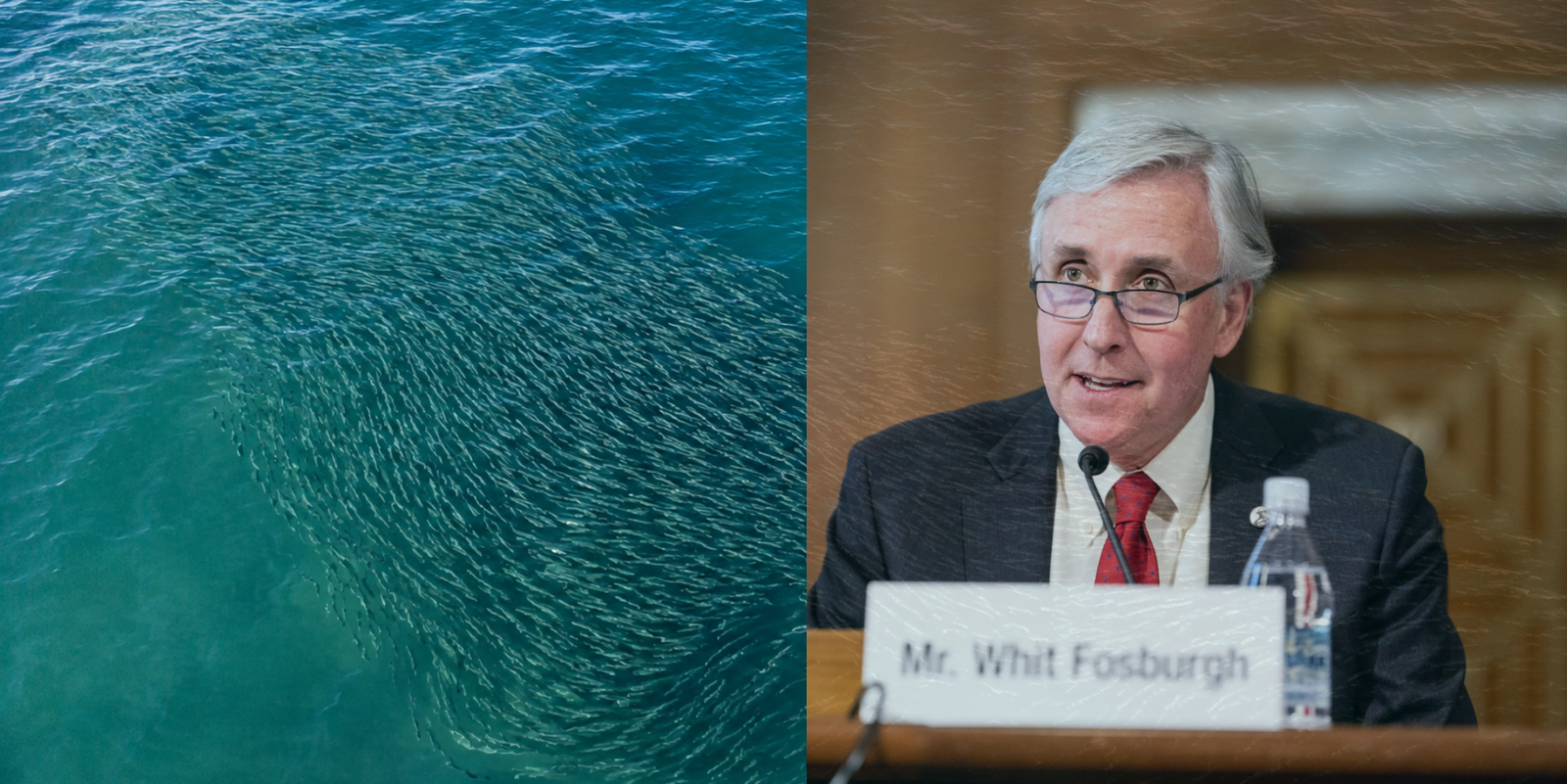
We recently had the opportunity to sit down with Whit Fosburgh, Executive Director of The Forage Fish Campaign.
For more than three decades, Whit Fosburgh has worked at the intersection of conservation and public policy, helping shape how America protects and manages its natural resources. He’s seen conservation wins, political shifts, new threats emerge, and old debates resurface under different names.
Thirty years in the field gives Whit a rare perspective on how conservation has evolved, what’s actually working, and where the same challenges continue to surface.
Whit is now Executive Director of The Forage Fish Campaign, a national effort focused on protecting the small but essential fish that support marine ecosystems, recreational and commercial fisheries, and America’s coastal economies.
In 2026, oakpool began working with Whit and his team to help launch and grow the campaign across digital channels and earned media. Since then, the campaign has brought the forage fish issue to new audiences across the country, with recent coverage in The Washington Post, Fox 5 DC, and NTD News.
We sat down with Whit to talk about what three decades in conservation have taught him, why some of the biggest challenges remain stubbornly familiar, and what it takes to build a conservation movement that can actually break through today.
You’ve spent basically your entire career in conservation, from Audubon and Capitol Hill to Trout Unlimited, Theodore Roosevelt Conservation Partnership (TRCP), and now The Forage Fish Campaign.
What got you into conservation in the first place?
Whit: Growing up in the woods of upstate New York and fishing! My father worked for the NY Department of Environmental Conservation, and we had a trout stream that ran through our property with little native brook trout. My brother and I were semi-feral kids who learned to appreciate wild places at an early age.
You’ve had a front-row seat to the conservation movement for more than 30 years.
What has changed the most over that time? And what hasn’t changed nearly as much as people think?
Whit: The nature of the challenges has changed. We’ve addressed things like rivers catching on fire and lakes denuded of fish from acid rain. We have far more deer, elk, bear and turkey today than we did a century ago. But today we have the constant pressure of development on open spaces and wild places, and we have a changing climate that poses real threats and that management has been slow to recognize, much less address. A perfect example is forage fish management.
A century ago, there were probably 100 reduction plants up and down the Atlantic, grinding up menhaden (aka bunker or pogie) for meal and oil (a replacement for whale oil). One by one states shut them down because they were so destructive, leaving only one plant in one state, Virginia. But technology changed, and that one plant now grinds up more menhaden than 100 plants likely did in the early 20th century. And we are seeing the consequences; as baitfish are disappearing, so are predators, from striped bass to osprey. The world is changing, including our oceans; does it make sense to pretend that everything is the way it was and remove billions of menhaden, the foundation of the coastal ecosystem, from our oceans every year? I don’t think so.
Hunters and anglers have historically been a pretty effective political constituency.
Why do you think sportsmen have been so good at getting conservation issues over the line? Is that still true today?
Whit: Going back to Theordore Roosevelt, anglers and hunters created the modern conservation system by eliminating market hunting, creating the best public lands network in the world, restoring degraded habitats and creating mechanisms where we pay for conservation every time we buy fishing and hunting equipment, motor boat fuel, licenses and tags. And today that continues because we represent Democrats, Republicans and Independents. In a polarized time, conservation and fishing and hunting represent areas of real bipartisanship.
You’ve also spent a lot of time working with the outdoor industry.
What role do you think outdoor brands should actually be playing in conservation? What separates the companies that genuinely help from the ones that are mostly marketing around it?
Whit: The best brands understand that supporting conservation, with money, advocacy, and education, makes good business sense. Anyone who is in the business knows which companies walk the walk as opposed to just talk the talk. For the conservation-minded companies, it’s in their DNA. Look at Orvis, Yeti, Patagonia, Grady White, Yamaha and many others like them. It’s fundamental to who they are and it shows. My fear is that as private equity continues to gobble up brands, that commitment will wane.
After TRCP, you could have gone in a lot of directions.
Why the Forage Fish Campaign? Why was this the issue you wanted to take on next?
Whit: Running TRCP was an amazing opportunity, not just because i got to work with 60+ other NGOs to advance conservation, but because of the breadth of the issues, from conservation in the Farm Bill and managing our public lands, to water conservation in the West and forage fish management along our coasts. But there is a downside to such breadth, such as political trade-offs and getting spread too thin.
I figure I have one good gig left in me before I focus on enjoying the outdoors and spending more time with family and friends. I’ve largely been a fish guy for my entire career, and I think we have a chance to change the world for the better by eliminating industrial fishing on the forage base. That’s the Forage Fish Campaign. It’s easy to understand and it is unique. We’ve been pounding these fish so hard and for so long that no one alive actually knows what abundance is. If we succeed, it will benefit every predator species, from striped bass, redfish, tarpon, tuna, bluefish, cobia, Spanish mackerel, and weakfish, among others, as well as osprey, whales, and everything else that eats them. It will also revive our coastal communities, including working waterfronts that are struggling to survive.
For somebody who doesn’t know much about fisheries management, why should they care?
Whit: As we used to say at Trout Unlimited, if you take care of the fish, the fishing will take care of itself. If we want healthy oceans and fisheries, let’s make sure they have enough to eat. And it’s 2026; does it really make sense to remove more than 4 billion fish from our waters every year and grind them up to feed aquaculture fish and pets, mostly in other countries?
You’ve seen a lot over the course of your career.
Are you optimistic about where conservation is headed right now? What do you think the conservation world isn’t paying enough attention to?
Whit: You have to be an optimist to be a fisherman. The next cast might be the one… The same is true in conservation policy. It’s easy to get down, but the wins can literally change the country. For example, The Great American Outdoors Act, signed into law in President Trump’s first term, is something that Democrats and Republicans had tried to pass for more than 50 years and it finally all came together. The early environmental laws like the Clean Water Act and the Clean Air Act are other examples.
If there is one area where we need to focus it is that history teaches us that it’s a lot cheaper and more effective to prevent the damage in the first place than it is to fix the messes that we have created. We are at that point with forage fish. The world is changing rapidly, and we need to do the right thing before it is too late.
We’ve obviously had the chance to work together on the Forage Fish Campaign.
Where have you seen the oakpool team make the biggest difference so far?
Whit: Changing policy starts with changing opinions and creating engagement. This is what oakpool is bringing to the table for the Forage Fish Campaign. It helps that a lot of the team at oakpool fishes and they are passionate about the outdoors and the environment, so the messaging is authentic, smart, and engaging.
And putting you on the spot a little:
If another conservation organization asked you what it’s like to work with oakpool, what would you tell them?
Whit: For oakpool, conservation is part of its DNA. And they deliver.
Last question.
After all these years doing this for a living, what still gets you excited to get outside?
Whit: It’s all about the experiences, from a bass blitz off Montauk and a blanket hatch on a remote trout river to a deer crunching toward you in the woods and a turkey answering your call. But as many have found, as you get older it’s more about introducing others to those experiences than just racking up more for yourself. Although I rarely turn down a trip offer.
If you’re interested in supporting The Forage Fish Campaign, please go join the coalition and fund the fight.
You can follow along with The Forage Fish Campaign on Instagram, Facebook, TikTok, and X.